

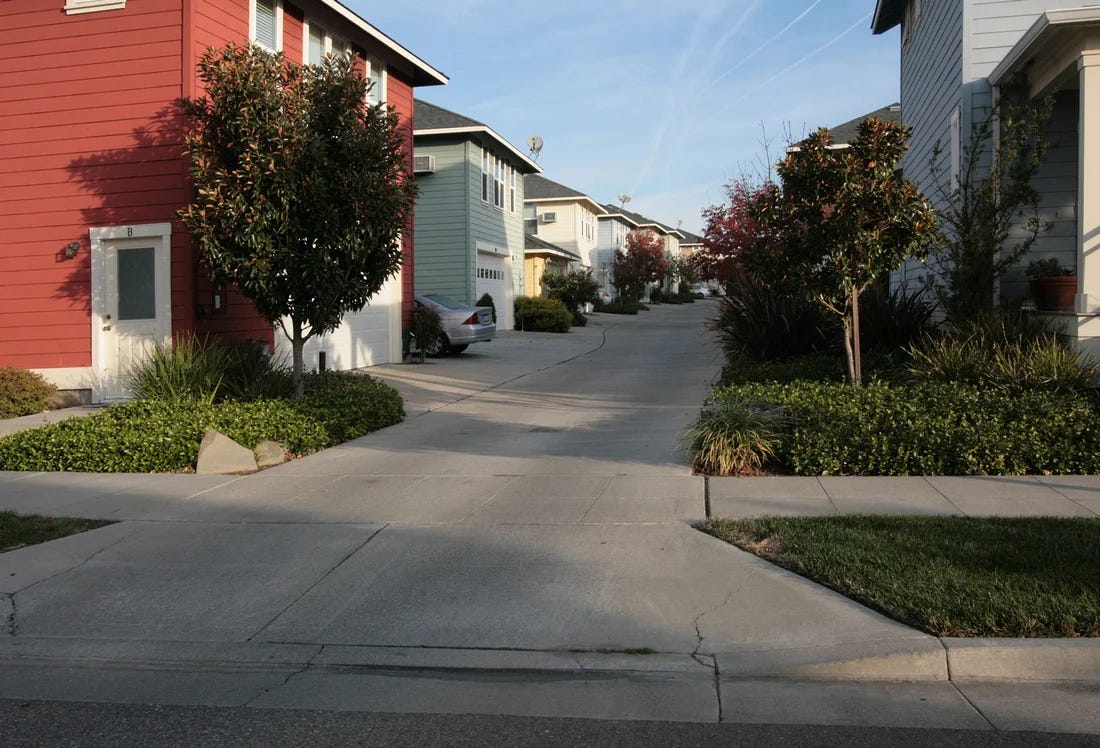
Building a simple alley delivers a number of benefits.
Garage doors come off the front of the house and go in the back. Driveways go in the back and another parking space is now available at the curb in front of the house where the driveway used to be. Electric, gas, phone and cable TV services (“dry utilities”) go in the alley. That means there isn’t a transformer and a clutch of green/grey utility pedestals in the front yard.
Unfortunately, just because something is simple doesn’t make it easy. Some fire departments would like to reserve the possibility they could drive fire trucks down the alley. They would like the alley engineered to handle the movements of a 40 foot ladder truck.
No. Do not turn an alley into a formal Fire Apparatus Access Road. (The technical requirements for such a road are found in Appendix D of the fire code). You don’t need to over-build the alley. The street in front of the house is Fire Apparatus Access Road It already exists, so you don’t need to build a second one.
The fire hydrants are in the front. The fire can be fought from the front, just like firefighters do in places without alleys.
An alley may have to accommodate the local garbage truck. If your municipality will collect garbage in the alley, the turning radius of the garbage truck should guide the geometry of the alley pavement. Some places have trucks with a hydraulic loading arm on one side of the vehicle. That can require two trips through the alley. Instead of two trips, all the cans to be arranged by the residents on one side of the alley.
Stay tuned for more technical particulars on alleys. (photo by Sandy Sorlien)
If you are building straight forward rowhouses with tuck under garages, setting up the alley to be a formal Fire Access Road per Appendix D in the fire code and putting the fire hydrants in the alley to provide for an engaged green or a pedestrianized street in front could be workable.
The reason why I would try to talk you out of it is what you give up when you give the alley over to wide pavement to create a place for people who are not in vehicles in the front is because that is a serious departure from what I consider best practices in planning, development, and urban design.
Ideally you want to design and build a connected network of streets and alleys where the drivers feel like they should be driving slowly. Encourage cars to be parked parallel along curb and lanes no wider than 10' with no centerline stripe. Detail intersections with care to make the place safe for people crossing the street or riding bikes and scooters. If the street is intentionally built as a shared public space, and the alleys are designed to acomodate garages, utilities, access to surface parking, and the occasional basketball hoop, then people will drive slow there as well. The alley is shared public space. Kids like hard surfaces to play roller hockey and ride their bikes, so the way an alley is built should make them safe and make drivers careful. The properly designed and built slow speed street and the properly designed slow speed alley should work together as a system.
In addition to the plan and section for the street and alley, crank the streets so that a driver's view is deflected. Use T intersection more frequently that four way intersections so that a driver's view is terminated with a building.
Make the alley 22 or 26' clear for the fire trucks to operate and people will drive fast.
If you have a main house facing the pedestrian green street or engaged green with a rear yard and a garage of carriage house on the alley, the fire official will look at the plan thinking that they will need to deploy their ladder truck with outriggers to fight the fire in the house in front with a fire fighter up on the ladder with the hose. Ladder truck with outriggers means a wide clear zone in the alley that will folks headed to their garage at higher speeds than they should.
Does that help?
I know you warned against this, but what if you *did* make the alley into a Fire Apparatus Access Road, and then pedestrianized the street in front of the house?