

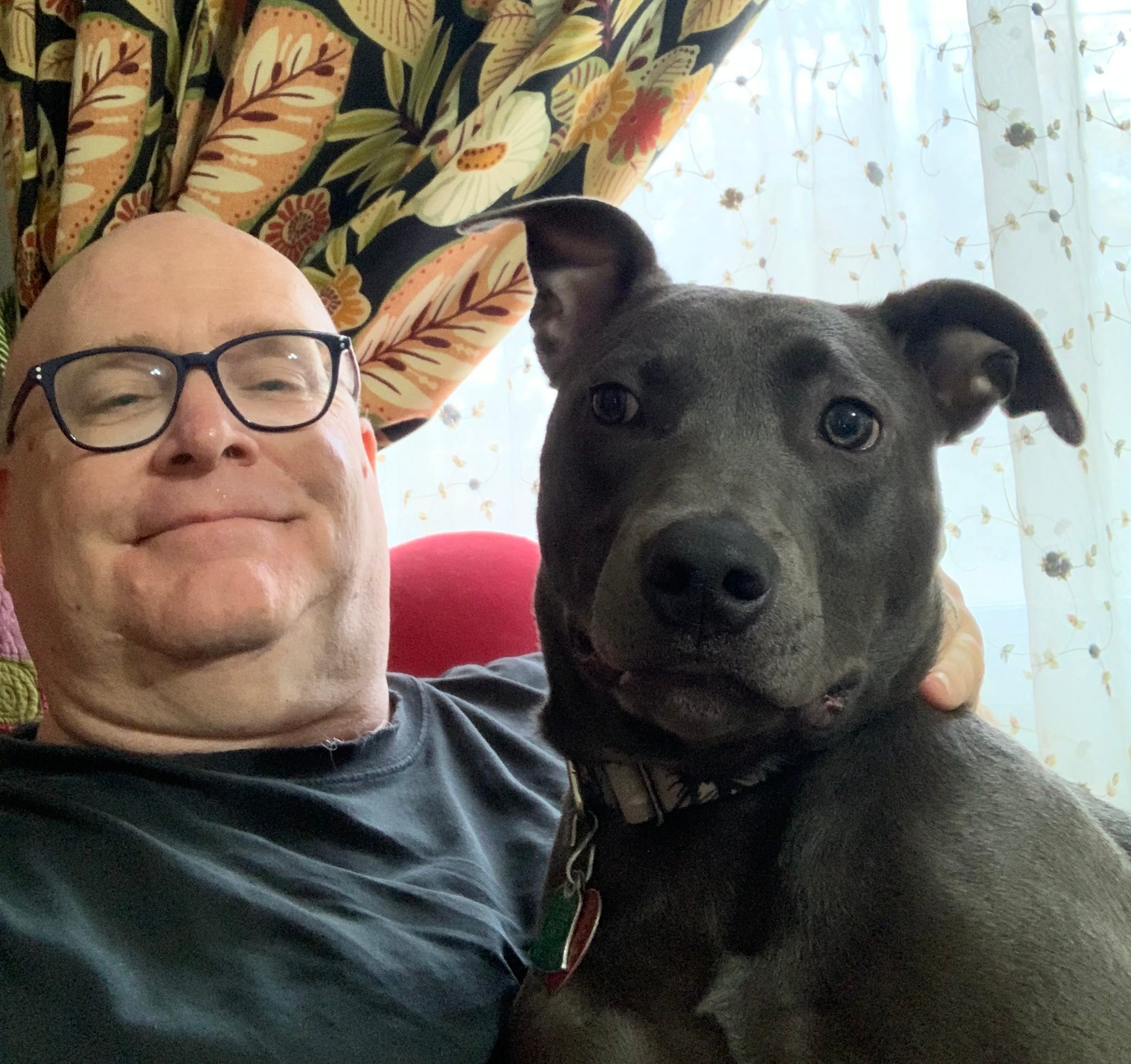
I went looking for a public domain image that illustrates trust. I gave up. Here is a photo of me with my trusted dog Trouble.
I recently saw a Slack post wondering “What universal metric could help municipalities to see the need to change the rules on the books that shape their pattern of development?”
The key metric deployed in MoneyBall that allowed the Oakland As to shape a wining team with no money, was the statistical likelihood of a batter getting on base. I suspect that the key metric for small developers is the ability to build trust with their neighbors as the foundation for building trust with the elected officials and building trust with the city staff.
If your neighbors don’t trust you, they show up and push elected officials to deny any discretionary approval needed for your project. Even if your efforts are supported by the town’s adopted policies, elected officials will find some excuse to deny approval. If they can’t deny your application outright, they can table the decision and ask the staff to give them more detail. That can easily produce a 60 to 120 day delay.
In an environment where the existing zoning is terrible, at some point you are going to need to ask for a variance, a text amendment to an ordinance, or some frustrating Planned Unit Development (PUD) approval. Those changes and exceptions will require a noticed public hearings and votes by the elected officials. You may be able to build within the terrible zoning rules, but if the rules are bad enough you will probably push to change the rules. If you have not built substantial trust with the local residents, (your neighbors) you are vulnerable to being denied when it comes to a vote of the planning commission or city council.
It is IncDev canon to tell emerging developers to start small and build as of right project, to operate within the system, (no matter how lousy and counter productive the rules are). There are two reasons to start small.
Learn the system and the players under the current rules.
Build trust with your neighbors.
Structural change happens at the speed you can build trust. Why would you need trust if you are doing what is so obviously the right thing? Because people are afraid of change. Humans are incredibly emotional creatures driven by feelings. They are at the same time, capable of rational thought and analysis if they feel like it. Someone breaking with the way things have been done has to have the trust of their neighbors.
I don’t know how you would clinically measure how much your neighbors trust you like an on-base percentage.
A municipality can test the metrics of infill would be to count up the vacant properties within a given neighborhood and measure what if anything gets built, then figure out who is building/rebuilding and how they are getting on base. Then they can start looking at what obstacles limit those intrepid souls.
The city is rarely the active ingredient, the catalyst, in creating a culture of relentless incremental improvement, because it takes a lot more time, attention, and consistent action for a municipality to gain the trust of their residents than it does for an individual who is building/rebuilding well and communicating effectively. Think about it. How many of your elected officials actually understand basic developer math? Face it most of them still don’t understand the city budget they vote on after two or three terms on the council.
How many of the senior city staff have a working knowledge of developer math? When would they have learned that? In some university class? On the job at the city? The basics that drive our ability to build/rebuild are just not available to them.
If the folks in charge of running things don’t understand the relentless math, and practical day to day realities of building, how are they going to understand what pieces of the zoning ordinance or the parking requirements kill good projects? Where would they ever learn that math? They might get a clue on the math by attending an IncDev training, but more realistically, they will probably need to learn it from a trustworthy local small developer (who has the support of their neighbors). If the local culture has established that developers only care about money and are morally compromised people, city staff and elected officials are likely to feel like it is their job to protect the public from the sleazy machinations of all developers. Given the activities of some developers, that is not unreasonable.
Elected officials come and go. Senior members of the city staff come and go as well. An effective staffer is often recruited by another town. Who does that leave? The residents. If your neighbors don’t trust you as their local small developer, they will continue to be the critical constraint on your efforts.
The feelings of your neighbors are a serious constraint to move beyond building as-of-right projects. If they don’t feel like they can trust you, you will be seriously limited in any effort to change the rules on the books and the local culture of building. In other words, you are not likely to score runs if you can’t get players on base. What are the constraints interfering with your ability to get players on base?
The key metric that is deployed in MoneyBall is the statistical likelihood of a batter getting on base. I do not have the data to back it up, but I suspect that the key metric for small developers is the ability to build trust with their neighbors as the foundation for building trust with the elected officials and building trust with the city staff.
If your neighbors don’t trust you then they show up and get the elected officials to deny any discretionary approval needed for your project. The elected officials will find some excuse. If they can’t deny your application outright they table the decision and ask the staff to give them more detail.
In an environment where the existing zoning is terrible, at some point you are going to need to ask for a variance, a text amendment to an ordinance, or some frustrating Planned Unit Development (PUD) approval, and approval that requires a noticed public hearing and a vote by the elected officials. You may be able to build within the terrible zoning rules, but if the rules are bad enough you will probably push to get an exception or change the rules. If you have not built substantial trust with the local residents, (your neighbors) you are vulnerable to being denied when it comes to a vote of the planning commission or city council.
It is IncDev canon to tell emerging developers to start small and build as of right project, to operate within the system, (no matter how lousy and counter productive the rules are). There are two reasons for this.
Learn the system and the players under the current rules.
Build trust with you neighbors and from their trust with the elected officials and city staff.
Structural change happens at the speed you can build trust. Why would you need trust if you are doing what is so obviously the right thing? Because people are afraid of change, so being right is never enough (no matter how right you are). Humans are incredibly emotional creatures driven by feelings. They are at the same time, completely capable of rational thought and analysis if they feel like it. Someone breaking with the way things have been done has to have the trust of their neighbors.
I don’t know how you would clinically measure how much your neighbors trust you like you can measure an on-base percentage.
One possible way a municipality could test the metrics of infill could be to count up the vacant properties within a given neighborhood and measure what it takes to get anything built, then figure out who is building/rebuilding and how they are getting on base. Then start looking at what obstacles limit those intrepid souls. Consider the scale local infill builders are operating at compared with conventional large scale developers. The rule passed to limit what the big operators do can be disproportionately impacting small operators. A $20,000 development impact fee per dwelling unit means a 4,000 SF house has to pay $5 per SF. The same development impact fee paid by someone building a 500 SF apartment pays $40 per SF.
The city is rarely the active ingredient, the catalyst, in creating a culture of relentless incremental improvement. That active ingredient is more likely to be the small local developer. It takes a lot more time, attention, and consistent action for a municipality to gain the trust of their residents than it does for an individual who is actively building/rebuilding well and communicating effectively. Think about it. How many of your elected officials actually understand basic developer math?
How many of the senior city staff have a working knowledge of developer math? When would they have learned that? In some university class? On the job at the city? The basic math and risk assessments that drive our ability to build/rebuild are just not available to them. When would residents have access to this knowhow if local developers they encounter are not sharing it?
If the folks in charge of running things don’t understand the relentless math, and practical day to day realities of building, how are they going to understand what pieces of the zoning ordinance or the parking requirements kill good projects?
Where would they ever learn that math? They might get a clue on the math by attending an IncDev training, but more realistically, they will probably need to learn it outside formal council meetings from a local small developer (who has built the trust of their neighbors). If the local culture holds developers are morally compromised people only care about money, city staff and elected officials are likely to feel like it is their job to protect the public from the sleazy machinations of all developers. Given the past activities of some developers, that is not unreasonable.
Elected officials come and go. Senior members of the city staff come and go as well. An effective staffer is often recruited by another town. Who does that leave? The residents. If your neighbors don’t trust you as their local small developer, that will continue to be the critical constraint on your efforts.
The feelings of your neighbors are the key to moving beyond as-of-right projects. Neighbors who don’t feel like they can trust you, will constrain any effort to change the rules on the books and the local culture of building. In other words, you are not likely to score runs if you can’t get players on base.
I have met way too many elected officials who really do not understand their town’s budget and the the town’s financial position (even after 2 or 3 terms on the council…)
The best metric for helping elected officials, senior staff, and residents to get a handle on their town’s money is the Finance Decoder produced by Strong Towns.
https://www.strongtowns.org/decoder